- March 26, 2026
- By: admin
- in: Updates
The challenges and opportunities to small acreage farming are special. Although the size of land can be small, efficiency and accuracy are still vital to enable harvesting to be profitable and on time. The type of harvesting equipment adopted can greatly influence the labor needs, costs of operation and the end quality of crops. The trick to making the right choice is to understand what your farm needs and to find the right machinery to fit.
Small farms usually cultivate wheat, paddy, maize, pulses or fodder usually over irregular shaped fields. Small acreage operations unlike the large commercial farms do not need complex equipment and instead, their equipment is simple to use, cheap, and able to navigate through narrow areas.
Small farm harvesting equipment should be efficient and simple at the same time. Machines that are too big can be cumbersome, expensive to maintain and not suitable in small pieces of land.
It is of great essence that crops are gathered on time to avoid over-ripening, lodging or sudden changes in weather which can lead to loss of crops. Harvesting manually may be tedious and time consuming, which usually causes delays at the seasons of high demand.
The proper machinery allows farmers to make their harvests quicker and more consistent. Effective harvesting will guarantee improved quality of grains, fewer losses incurred and a faster turnover of fields to the next crop round.
The size and shape of your fields will significantly influence the nature of the harvesting gear which will be necessary. Compact machines are also useful in small and irregular fields that may follow corners and narrow routes with ease.
Using equipment that fits in fields enhances coverage and minimizes unharvested areas.
Various crops have various harvesting systems. Cereal machinery might not be applicable to fodder or oilseeds crops. Knowing the type of crop, their height, moisture level and the potential yield can be used to choose the correct harvesting solution.
Crop specific equipment will also result in clean cutting and efficient threshing of the produce without causing any damage to it.
In case of small farms, it is very helpful to have machinery which is easy to maintain and operate. The basic control would lower the learning curve and lessen operational errors.
The machines with less technical knowledge enable farmers to handle the harvesting process without involving the services of skilled workers so much.
Small acreage farmers are also very much concerned with budget. Harvesting equipment should be considered with a long-term perspective as opposed to the initial cost.
Lower fuel consumptions and less maintenance means in affordable machines bring in better returns. Availability of spare parts and after sales services must also be taken into account in order not to lose harvest time in case of a problem.
It is becoming increasingly evident that labor deficit is a phenomenon especially in the harvesting seasons. The use of harvesting equipment eliminates the need to depend on human labor and enables farmers to do their work in time.
Harvesting machines that incorporate several functions in a single process save time and avoid the use of extra equipment or labor force.
A small acreage farm may also crop rotate or produce two or more crops in one year. The option to select harvesting equipment with the capability to be changed according to the crop would enhance its utility and worth.
Flexible machinery enables the farmers to utilize the maximum number of machines in various seasons and enhance the overall cost effectiveness.
Small harvesting machines can be easily transferred between fields and they need small storage areas. This is especially significant to the farmers who have low infrastructure.
Movable machines are light and can easily be transported, thus decreasing the logistical problems and simplifying day-to-day operations.
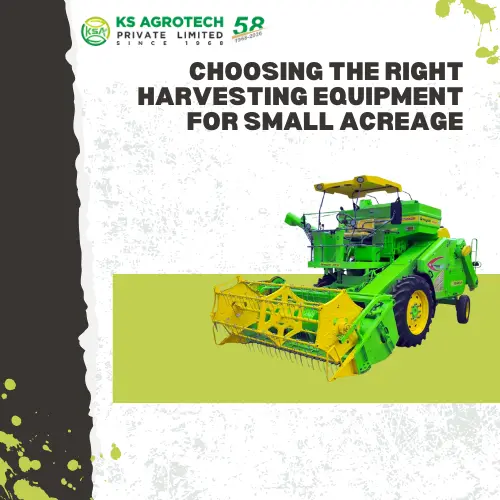
In small land plots, medium-sized harvesting machines are the best alternative solutions since they are efficient but not complex as large machines. Many farmers consider options such as a mini harvester because it combines essential harvesting functions while remaining suitable for limited acreage.
These solutions can be used to substitute the manual harvesting with a large scale mechanization.
Smaller machines have a lower compression of the soil, which minimizes the soil compacting and maintains the soil structure. This is particularly effective in the long-term soil health and sustainable production.
The consumption of fuel is also efficient which helps reduce the emissions hence compact harvesting equipment is an eco-friendly decision.
Once the decision regarding the harvesting equipment to be used in small acreage has to be made, then a lot of consideration must be given to the size of the farm, the type of the crop, budget, and operational requirement. The farmers have to evaluate the frequency of the equipment utilization and its correspondence to long-term objectives of agriculture.
Farmers can make good decisions to enhance their productivity and profitability by consulting with their suppliers of equipment, knowing specification of the products, and comparing products.
The choice of harvesting equipment is vital in small acreage farms towards efficient and sustainable farming. Small and user-friendly machines allow small farmers to harvest in time, decrease dependence on labor, and enhance the quality of crops. Small acreage farms would be able to be highly efficient and produce consistent results season after season with the right equipment in place.