
- March 24, 2026
- By: admin
- in: Updates
The contemporary farming is fast changing under the assistance of innovated technologies and intelligent tools. Among the changes, it is possible to outline the manner in which farmers handle animal fodder. As dairy and livestock industries grow, the farmers are currently in need of effective systems that would save time and labor as well as provide high-quality feed. This is where the accuracy of agriculture methods are converging with the contemporary forms of forage management and now a new phase of productivity and sustainability of livestock farming is being born.
Since it is now possible to monitor crop development using data and advanced farm equipment can be utilized, farmers have more control over feed quality than they have ever had. Such advancements have not only been enhancing livestock nutrition, but also farm profitability.
The economy of livestock food is based on forage, particularly in dairy production. Animals need a healthy feed, which is abundant in nutrients, fermented appropriately, and stored in the best environment. The nutritional loss, poor milk production, and even health issues among the animals can be caused by poor harvesting or processing of fodder.
In conventional agricultural systems, foddering was a tedious process, which was not always continuously. Crops were harvested by hand, or using rudimentary machinery, and uneven harvesting and poor fermentation were a common occurrence. This has however been enhanced by modern mechanization.
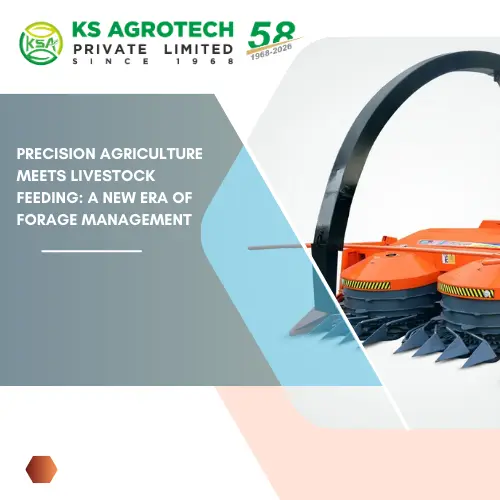
Today, machines like the silage harvester machine allow farmers to harvest crops such as corn, sorghum, and grass efficiently while maintaining the right particle size required for proper silage fermentation. This is done to make sure that livestock are fed on foodstuffs that enhance their nutritional value over extended periods.
Precision agriculture is the application of technology to treat and oversee crops more accurately. GPS guidance, crop sensors, satellite images, and farm management software are all tools that enable farmers to make informed decisions in real-time based on the available data.
The technologies applied to forage management assist farmers in making the decisions:
When these factors are used with the current harvesting machines, farmers will be able to harvest fodder with the most suitable maturity. This results in quality fermentation and digestion in the animals.
Large scale livestock production has been rendered to be mechanized. As the herd size increases, many farmers can no longer manually harvest the fodder. The modern forage harvesting machines are intended to have multi functions as they cut, chop, and collect the crop during a single operation.
A silage harvester machine plays a critical role in this process. It is effective at cutting green fodder into small uniform pieces which can be compacted and stored effectively in silage pits or bunkers. Optimal chopping makes sure that there are as little air spaces as possible in storage, which is needed in order to sustain anaerobic environments required in fermentation.
Labor needs as well as harvest time are also cut short by a large margin by this mechanized process. Farmers no longer need to spend several days harvesting fodder by hand, and now it can be done on a matter of hours and avoid the loss of nutrients that happens when the crops are in the field too long.
The quality of the silage has a direct effect on the productivity of livestock. Animals that have been fed on well processed and well fermented feeds are observed to have enhanced growth rates, increase in milk production and overall better health.
One of the aspects which influence the quality of silage is uniform chopping. The fodder pieces should be uniform in size as they stack better during storage. This minimizes the exposure to oxygen and promotes the growth of beneficial bacteria of fermentation.
The modern harvesting systems will also assist in ensuring that the appropriate moisture content of fodder is kept. Poor fermentation and mold growth may be achieved due to dry or wet crops. By using advanced equipment such as a silage harvester machine, farmers can achieve consistent chopping and better control over feed preparation, which ultimately supports better livestock performance.
Modern forage harvesting technology provides long-term economic benefits. The initial outlay of the machinery might appear expensive but the payback can be high considering that it will lead to a high output and less feed wastage.
Key economic benefits include:
In the case of dairy farmers, the quality of silage may result to increased milk production hence more farm income. The large scale harvesting also enables farmers to use up more of the fodder crops without having to fear of the shortage of labour.
Sustainability in agricultural activities is becoming the focal point in view of the challenges of climate change and scarcity of resources as well as increasing food demand. The precision agriculture and up to date forage harvesting technology contribute towards sustainable livestock production in many aspects.
To begin with, effective harvesting means that there is less wastage of crops and that the remaining nutrients found in the plant can be preserved to give rise to animal feeds. Second, data-driven farming enables farmers to optimize water and fertilizer application as well as reducing environmental impact. Lastly, mechanized systems assist farmers in operating large-scale businesses without exploiting the resources.
Technology is constantly developing, so future systems of forage management can encompass automated harvesting, AI-based crop sensing, and totally integrated farm data systems. Such innovations will also make livestock farming more efficient and sustainable.
Precision agriculture combined with the latest methods of forage harvesting is also changing how livestock feed is produced and processed. The union of data-driven decision making and sophisticated machinery will help farmers to guarantee a better quality of feed, a better condition of animals, and better efficiency.
Equipment like the silage harvester machine has become an essential component of this new agricultural landscape, helping farmers harvest and process fodder quickly and consistently. With farming increasingly becoming modernized, the implementation of such technologies will be critical in helping to maintain profitable, sustainable, and productive livestock production and operation.
