- June 4, 2026
- By: admin
- in: News
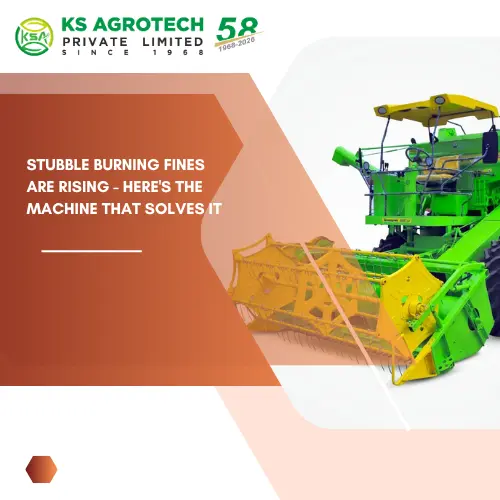
As the paddy harvest winds up every year, a well-known, costly dilemma reappears in the fields of Punjab and Haryana: what to do with the stubble? The quickest method of disposal for a long time was burning it. Increasingly, this “short-term solution” is emerging as the most expensive incident a farmer can commit.
The farmer faces steeper penalties for stubble burning each season, more powerful satellites monitoring for unauthorized burns, and the inescapable costs – from dangerous smog to degraded soils – to the environment and their health. Farmers now risk not just a fine but the future productivity of their soil, the harvest of their crop, and the profitability of their farm.
The silver lining is that avoiding non-compliance doesn’t require sacrificing convenience. With the appropriate equipment, you can make productivity out of that legal burden.
Responding to severe air pollution issues, authorities in North India have increasingly been tackling the problem of residue burning. Fines are escalating from rare reprimands to an ever more predictable price of burning (for example, in the peninsula it is often in excess of Rs 40001, equivalent to roughly 80 USD) and in some places are associated with curtailment of access to subsidy and minimum support price benefits.
That, however, is a very different story to a farmer. The “free” disposal of stubble suddenly becomes a real financial burden. Longer-term benefits of mechanised residue management – once dismissed as additional capital outlay – are now clearly visible as more sensible, safer, and often not more expensive,
What farmers tend not to understand is that paddy straw isn’t just something to be got rid of; it is for a farmer a resource. It prevents the window to sowing the next crop. It kills off the microorganisms in the soil, reducing natural fertility if burnt. When cut, spread and incorporated, it can be used to retain more water in the soil.
The question has always been ‘should stubble be burned’, not ‘how can we burn it more efficiently’.
This is where the KSA Straw Reaper truly redefines the paradigm. Not pyrolising residues, it machine-harvests wheat and paddy straw (30-50%) in one pass – clearing the field in a record time to fit in the tight harvesting window, with not a fuse or match being lit. The cultivating width of 2,390 mm plus the machine’s ability to harvest nearly an acre of wheat/ paddy per hour demands a machine that performs within the pace of Indian harvest seasons.
Which is what it has been designed for.
The harvested straw can then be sold as animal feed or used for other purposes, reaping additional income from what was previously a known liability.
For those farmers eager to take it a little further and go straight into the next crop, sowing directly into the straw and without even clearing the stubble, the BEW Super Seeder is the perfect addition. It paddocks the standing stubble and loose straw, then drills the seed into the soil in one operation. The flails cut and clear away the residue ahead of the seeding tines, leaving seed in a good state even in heavily strawed ground. Powered by a 50 HP tractor and capable of 0.4 hectare per hour, the BEW Super Seeder has left the need for even a separate stubble-clearing pass entirely behind, in one fell swoop.
The KSA Straw Reaper and BEW Super Seeder provide the farmer with two tested, government-approved methods to achieve the same result: a clean, prepared field without the burning of an acre.
Other than avoiding fines, adopting mechanized residue management has definite, quantifiable benefits:
A farmer with a few thousand rupees worth of machinery costs on his farm and thrown in some fines now and then and a rapidly degrading soil health, would find it quite clear cut.
If you are still managing to get away with burning after the crops have been harvested, now is the time to reconsider. The penalties will increase, and with heightened vigilance, early adopters will stay clear of trouble.
The transition doesn’t need to be difficult. A suitable implement – a machine designed to handle the size, velocity, and durability of Indian fields – will make clearing stubble just another fast, cost-effective process on the farm, not a legal liability.
This is where KS Agrotech Pvt. Ltd. gets involved.
With over 57 years of experience building agricultural machinery specifically designed for Indian conditions, KS Agrotech has assisted hundreds of thousands of Indian farmers in becoming residue farmers by offering them more intelligent, more profitable ways to deal with their straw.
From the KSA Straw Reaper to the BEW Super Seeder to the Diesel Engine powering it all, the entire line is designed, tested, and supported by a company that knows Indian soil, Indian crops, and Indian farmers firsthand.
Don’t let the break in the weather become the time to make your mind up. Play with the KS Agrotech team today and discover which stubble management system is appropriate for your land – a single-season investment that pays back time and time again.
Contact KS Agrotech Pvt. Ltd. Today for top-quality straw reaper and super seeder machines in India.