- October 5, 2026
- By: admin
- in: Updates
One of the most critical steps before planting a new crop is prepping the farmland. Whether it’s firm, rocky, or just uneven, the soil is more difficult to work with, limits the ability of the sowing process, hinders root growth, and creates an obstacle to more efficient farming practices. That’s where today’s agricultural equipment comes in.
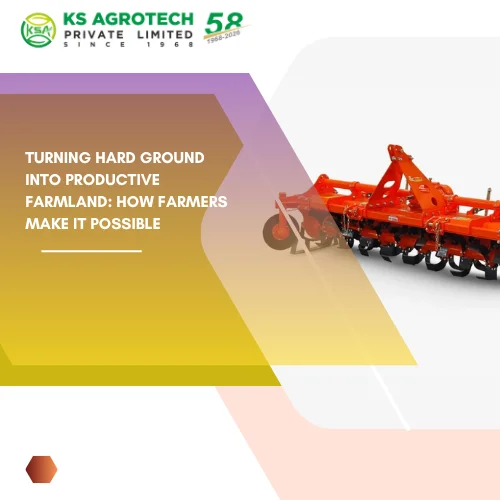
A Rotary Tiller is excellent equipment for this work and can prepare various types of farmland. This machine can operate by using blades that rotate, cut, and loosen the soil, which also helps in the production of a fine and even surface. Machinery works quicker and easier to do if it is used to prepare a larger area than if done by hand.
Soil pulverization is likely to be more effective if the soil is clean and moisture conditions are suitable for working. The previous crop and the crop to be grown are also relevant. Mechanical operations can assist with several aspects of field preparation, for example loosening the soil, crushing clods, leveling, and incorporating residues.
Knowing about the uses of a rotary tiller may aid farmers in determining whether this kind of machinery suits their field situation. It can be applicable in the fields for seedbed preparation, organic matter incorporation, mechanical weed control, and tilling previously tilled land.
It is also wise to examine the compatibility of the machine with the farm equipment. A Rotary Tiller for a tractor typically uses an attachment that is linked to the tractor through a hitch and motorized by the PTO drive of a tractor. This enables the user to take advantage of the tractor’s power to do a lot of plowing.
Core Equipment: A large, rotating shaft with blades, which resemble a piece of rebar, sits at the center of the equipment. The blades turn in the ground, reducing the soil from larger to smaller pieces as the shaft turns. Blade depth and effectiveness can depend on blade design, soil moisture, power of the tractor, and equipment settings.
A modern Rotary Tiller machine, on the other hand, can carry out one or several operations of working the land in one pass, depending on the conditions of the field and working environment. Reducing the number of passes can save on fuel consumption and time.
With reference to a Rotary Tiller diagram, the user can also easily learn how it works by identifying the rotor, the blades, the gearbox, the frame, the connection to the PTO, and the cover of the machine. This knowledge can be really beneficial in the regular inspections and maintenance of the machine.
The requirements for soil preparation can vary from crop to crop. A number of crops prefer a fairly fine seedbed, and other crops will prefer a different structure. Machinery needs to be selected to match the system and not just by size or what it looks like.
The agricultural uses of the Rotary Tiller can be seedbed preparation, mixing crop residues and other debris into the soil, surface clod breaking, and post-harvest cultivation. The Rotary Tiller can also be used in horticultural applications and small-scale cultivation.
Farmers should take into account the field size, tractor horsepower, operating width, soil quality, and hours of service before investing in machinery, as these can greatly influence the operating efficiency and total ownership costs.
Price has a significant impact on any agricultural machinery selection. The price of a Rotary Tiller changes based on the working width, construction quality, blade setup, transmission, manufacturer, and additional requirements. Farmers can evaluate machines not only based on purchase cost but also based on functionality.
Equally, do not look solely at the Rotary Tiller Price. Heavier use, frequent repairs, and mismatched tractor power mean that sometimes a lower cost upfront is not necessarily the best deal if you end up replacing it sooner. Looking for specifications and a robust build could pay off.
If you are a farmer who is looking at one for different kinds of implements, you may find Rotavator Price India to be helpful, as prices that are available on various websites can differ widely for various products and manufacturers.
Selecting a good Rotavator Manufacturer is also crucial. The manufacturer’s reputation in terms of manufacturing quality, warranty support, availability of spare parts, dealer network, and after-sales support are some of the factors that a buyer must consider.
Rotavators come in working widths and specifications to suit many different tractors and sizes of farm. The size should be appropriate for the HP of the tractor and condition of the ground. A Rotavator that is too wide for the tractor can affect performance, while one that is too narrow will require more passes to be taken.
Consider the following: Rotavator Price. Compare prices along with working width, blade arrangement, gearbox, weight, and quality of build, and it’ll be more meaningful.
In the case of bigger fields, the potential buyers might look for the Rotavator 8 feet Price. It will give a fair idea of what exactly the price of a wider Rotavator will be. A smaller working width can be found through the Rotavator Price 7 feet.
You should also look into local prices. For instance, a farmer requesting prices of Rotavator in Punjab, for instance, might see an enormous variation in dealers based on their city, transportation charges, seasonal demand, and other models.
Proper maintenance can have a significant impact on the operational life of farm machinery. You should make a habit of carrying out a thorough inspection of your blades on a regular basis, as they are in direct contact with the ground and are therefore subject to wear and tear.
Any Rotavator blade must be inspected for excessive wear and tear, buckling, cracks, and proper fastening. By changing worn-out parts and blades, you will be able to provide adequate preparation of the soil and minimize the effort exerted by other elements.
Additionally, it is wise for farmers to routinely examine bearings, shafts, gearbox parts, fasteners, guards, and lubrication. Do not get stuck during crucial fieldwork times due to missing frequently demanded Rotavator Parts.
It’s not just a matter of making a pass with the machine on the tough ground before turning it over to seed. The farmer has to think about soil moisture, the working depth, the tractor’s ability to pull it, the machine itself, and the next crop.
Such work can be carried out using modern equipment, making it easier and quicker to undertake, but the key to success is choosing the right implement in the right conditions. With effective choice, operation, and maintenance, agricultural machinery can enable farmers to prepare their land more effectively for the next crop.