- October 8, 2026
- By: admin
- in: Updates
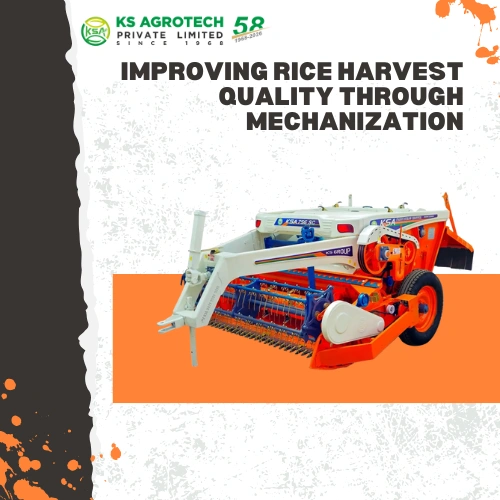
One of the most significant staple crops is rice which allows millions of farmers and consumers all over the world. Rice market value, storage life and profitability directly depend on the quality of rice that is harvested. Although harvesting processes are conducted in the old ways as generations, the concept of mechanization has emerged as a strong force to enhance efficiency and quality of harvest. The use of modern harvesting machines has assisted farmers in minimizing losses, retaining grain integrity, and finishing the harvesting process within the best time frame.
The conventional methods of harvesting rice are using labor and simple equipment. Although effective in small scale, this method has a number of challenges as the area of the crop grows or the availability of labor reduces.
The harvesting process that is carried out by hand takes time and results in asymmetrical harvesting, breakage of grains and soil or plant debris contamination. Late harvesting because of a shortage of labor may also lead to over-mature crops thereby causing losses and degradation of grain quality.
Mechanization brings in uniformity and accuracy in harvest. The cutting, collection and threshing (in some instances) can be done in one operation by using machines that harvest rice.
Mechanized systems are used to regulate the quality of grain and reduce wastage by reducing human error and even out the height of the cut. This uniformity is important in the generation of cleaner and more marketable rice.
The timing of harvesting rice is very crucial. Early harvesting may lead to incomplete grains whereas late harvesting may lead to the danger of shattering and lodging of the grains.
The use of machinery to harvest enables farmers to cover extensive fields within a short time, which means that their crops are harvested when they are at the optimum stage of maturity. Early harvesting conserves the weight of grain, balance of moisture and the general quality of the grain hence the improved harvesting storage and market returns.
Among the greatest benefits of mechanization, the decrease of grain losses can be mentioned. Manual harvesting mostly leads to loss of grains during harvesting, bundling and transportation.
The harvesting systems used by the mechanization industry are made to cure crops in a harmless and efficient way minimizing losses incurred during the harvesting and gathering of the crops. Better grain recovery leads directly to an increase in yields and better profitability.
Clean harvesting requires uniform cutting height. The use of mechanized equipment also ensures uniformity of cutting on the field thus avoiding both uneven stubble and contamination by soil and weeds.
Less cleaning and processing is required with cleaner output and this saves time and labor and enhances the overall appearance and quality of the resulting harvested grain.
The availability of labor has become an increasing problem in most agricultural areas. Mechanization ensures that farmers do not need big labor force to attend to harvesting activities but have a few workers.
By using machines such as a paddy reaper, farmers can maintain harvesting schedules even during peak seasons when labor shortages are common. This dependability will avoid delays and losses of crops.
Manual harvesting is laborious and puts the workers at risk of spending long hours working in the harsh conditions in the field. Mechanization ensures a better working situation because it lessens the physical load and enhances safety.
Machines also facilitate farmers to work on the harvesting process more quickly, which leaves time to do other significant farm activities like preparing fields and planning crops.
Although mechanization does demand an initial capital outlay, the economic gains in the long run are great. Lower labor cost, low grain losses and quality of grain have led to increased financial returns.
Increased quality of rice may fetch a superior price in the market further boosting farm revenue. In the long run, the investments and extra profits can be used to offset the original expenses of the mechanization equipment.
The aspect of mechanization serves sustainable farming in the sense that it minimizes the losses experienced after harvesting and enhances efficiency in the utilization of resources. Efficient harvest reduces wastage and enhances optimal utilization of land, water and inputs.
Residue management in a timely manner also contributes to the rapid preparation of the next crop cycle in fields, which support multiple crop regimes and enhance the sustainability of farms in general.
The small and medium-scale farmers can now access mechanization as there are modern harvesting machines of different sizes and configurations. Small and convenient machines enable farmers who have small land to enjoy the benefits of a mechanized harvesting method.
These solutions are used in closing the gap between traditional practices and the advanced technologies in farming.
Mechanization has emerged as a major contributor to ensuring that the quality of rice harvest is enhanced. Mechanized solutions allow farmers to have better harvests and produce quality harvests earlier, loss of grain, there is uniform cutting and less reliance on labor, thus saving the farmer money in labor. With the current development of agriculture, the adoption of mechanization of harvesting activities will be very instrumental in increasing productivity, sustainability and profitability in rice production.