- October 15, 2026
- By: admin
- in: Uncategorized
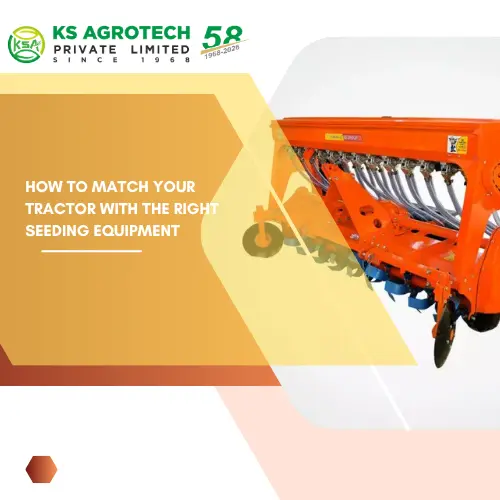
The selection of the appropriate seeding equipment is arguably the most critical decision a farmer makes today. Ensuring that the tractor and the seeding machine work well together can affect fuel efficiency, field efficiency, crop establishment, and grower profitability.
As interest in sustainable farming, precision seeding, and residue management grows, farmers are seeking to understand how tractor power, field conditions, machine characteristics, and operational factors integrate. Knowing the correct fitting combinations will help to lower operating costs and increase crop yields and field efficiencies.
This leaflet covers the eight key factors farmers should consider when matching their tractor to the optimal seeding equipment.
Often, a single item is purchased by the farm, be it a quality tractor or a modern seeder. But overall productivity is maintained only with the combined effect of these two.
Proper matching offers several benefits:
A mismatched setup can cause high fuel consumption, poor seed quality, uneven germination, and equipment damage.
Farmers should take the following into consideration when choosing the appropriate seeding equipment:
A machine which works well on a large commercial farm might not be the most appropriate on a smaller holding. Knowing what you need to do on the farm can help establish the best options.
Horsepower is one of the most important considerations when purchasing seeding equipment.
Different seeders require different power levels depending on:
A machine that requires more power than the tractor can deliver or is mismatched to the tractor. For example, using a small implement with a high-horsepower tractor will incur additional costs.
Farmers must always consider the manufacturer’s recommended power range before making a purchase.
Crop residue management is a growing concern in modern agriculture. Smaller fields with large amounts of stubble need machines that can handle the residue without disturbing the seedbed.
Presently, most farmers prefer the super seeder for residue management during sowing to minimize the time required for field preparation and support sustainable agriculture.
When choosing the tractor and the seeding tools, the amount of residue in the field should be taken into account.
Working width is important for efficiency.
A larger machine would cover more ground in a shorter time, but you would require significantly more pulling power from your tractor.
Optimizing working width relative to tractor power ensures maximum productivity.
Tractor weight, including the seeding machine’s weight, influences the machine’s performance, traction, and fuel consumption.
For instance, farmers evaluate data such as the KS Super Seeder 7-foot weight to ensure their tractor can support the machine during field operations.
Additional equipment that weighs too much can cause excessive soil compaction and potentially overstrain the tractor on long runs in the field.
Contemporary seeding equipment features multiple new technological attributes aimed at both efficiency and precision.
Use a superior super seeder machine to enhance planting efficiency, save labor, and reduce operating expenses.
Farmers decide which features to incorporate based on their farming goals and crop needs.
Equipment quality will have a significant impact on the long-term result.
Dealing with an established super seeder manufacturer in India typically provides greater confidence in machine reliability and after-sales support.
Better equipment usually means a better return over time from less maintenance and higher performance.
Le mode de culture varie selon la région de l’Inde. La nature des sols, le pourcentage de déchets, le climat et la variété cultivée influencent le choix du matériel.
Farmers eager to find the best super seeder in Punjab often look for equipment that meets certain expectations, including the capacity to manage heavy paddy straw residue and to align the wheat sowing operation with time constraints.
Select equipment adapted to the specific conditions encountered on local farms is more likely to perform better and operate more efficiently.
Although affordability is still a consideration, farmers should be assessing value rather than simply purchase price.
The best super seeder is not the least expensive but the one that performs consistently well for years to come.
Cost investments in superior machinery tend to be cheaper in the long run because operating costs are reduced.
The system’s uptime can be significantly affected by the availability of services and spare parts.
Local support from a reliable super seeder producer in Punjab is often desirable by many farmers to minimize field downtime and to provide quick maintenance.
A high level of after-sales service helps to guarantee satisfaction over the long term.
India has a variety of equipment and Indian manufacturers for seeding equipment.
Farmers evaluating the best super seeder in India should compare:
I conduct thorough research to find equipment that meets operational, usage, and budgetary requirements.
Choosing the tractor itself in relation to field requirements and the equipment needs.
Require farmers to compare the specifications of the best tractor for a super seeder.
A tractor that is correctly matched. Efficient and accurate planting.
Some common equipment matching mistakes include:
Eliminating these errors can ensure machinery efficiency is at an optimal level for profitability.
Choosing the proper seeding equipment to match the tractor can increase efficiency and farm profitability. All the aspects of need for the tractor and equipment, including horsepower, the weight of the equipment, working width, conditions of the field, field residual types and amount, as well as support from the manufacturer, are viewed by the author.
A timely investment in productivity-enhancing machinery improves efficiency, lowers operating costs, and enables better crop establishment. A combined assessment of tractor specifications and seeding needs enables farmers to develop a sustainable farming system, which can be profitable in the long run.