- October 15, 2026
- By: admin
- in: Uncategorized
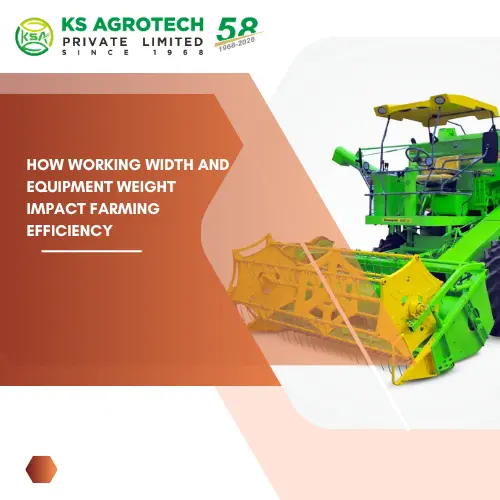
Today’s farming relies heavily on implements and machinery that operate efficiently in the field to provide consistent and reliable performance. An agricultural implement’s working width and weight are significant considerations, impacting coverage, efficiency, and crop establishment by affecting factors like fuel consumption and soil compaction.
Working width-the area covered in a single pass- is wider for the equipment; fewer passes are required to cross a field, and the work will be completed faster.
Larger working widths can improve productivity by:
Nevertheless, selecting the broadest implement may not always be the most effective. It is important to select the implement that is appropriate for the power available and the field conditions.
The weight of the machine is one of the most important factors determining stability, penetration, and durability. Usually, the heavier the machine, the better the contact with the ground. This is true especially in the presence of crop residue or rough soil conditions.
The right balance of weight helps:
Heavyweight, though, can cause greater compaction in wet fields, which might hinder the growth and root development of crops.
Working width and machine weight should be balanced against each other. If you use a wide implement that is too light, it will not be able to maintain good ground contact. Conversely, if the machine is too heavy, it will need more tractor power to operate.
Farmers should evaluate:
Select the right mixture, and things will run smoothly as long as you keep going efficiently during the season.
Using equipment that is not suitable for the tractor horsepower can limit productivity. The larger the implement, the more horsepower you need.
Numerous farmers looking for the best tractor for super seeder compare the tractors by engine power, hydraulic capacity, and lifting capacity, etc. With the working tools they are going to attach to the tractor. Proper balance helps to prevent the tractor from getting overloaded and increases performance in the field.
Generally speaking, wider equipment is more efficient on large fields due to the reduced number of times equipment needs to be passed over the job. On smaller or more irregularly shaped fields, a narrower working width may prove more suitable as the operator has more control and range of motion.
Suppose farmers consider the KS Super Seeder 7 feet, etc. When weighing machinery alternatives for a medium-sized farm with similar concerns for high productivity and equipment operation.
While more weight usually means a machine will have an easier time in difficult terrains, too much ground pressure can result in ground compaction.
To minimise this risk, farmers should:
Soil structure protection promotes more vigorous crop production and enhances sustained yields on farm operations.
Build quality is a critical feature on equipment, alongside working width and weight. A solid, well-built machine is more robust in the field and generally requires less maintenance.
Numerous farmers tend to be supportive of a well-established super seeder manufacturer in India that provides sound engineering, quality-sourced components, and reliable after-sales backup.
Locally manufactured equipment may mean faster service, more readily available spare parts, and better adapted to the local farming environment.
Growers often favor products of a super seeder manufacturer in Punjab, where farming equipment is designed to suit local crop stubble management needs.
All farms have varying needs in regard to machinery, so it is a matter of assessing what is needed rather than just considering one specification.
Farmers use these criteria to compare different best super seeder options:
Likewise, many growers also look for the best super seeder in Punjab and the best super seeder in India, keeping in mind the performance in the field, its reliability, and the reputation of its maker before one makes a purchase.
Prior to investing in agricultural equipment, look over the technical specifications of the machinery. Specifications like the super seeder machine design and super seeder weight will determine transportation, field operation, tractor compatibility, and other considerations.
Having knowledge of these specifications, farmers can confidently choose the right blender to meet their needs without falling for marketing hype.
Working width and machine weight are among the most important considerations in increasing farming efficiency. Balancing equipment for a specific tractor, field and future design ensures the operation is more cost-effective, productive and easy to control while maintaining the soil structure. Rather than picking the biggest or heaviest implement, it’s better to weigh (pun intended) the choice against tractor size, field conditions and where you want to be in five years.