- October 15, 2026
- By: admin
- in: Uncategorized
Contemporary cultivation is carried out using various forms of machinery that relieve the daily field operations of human labour, making them quick, effective, and less time-consuming. Several machines are used to do various tasks such as harvesting crops, handling residue, and tillage; all have their unique functions that can be compared according to the crop to be grown, the size of the field to be handled, tractor size, and other varied factors.
There are many different types of machines used in Agriculture, some of the more popular being combine harvesters, tractors, balers, rotovators and specialised straw handling machines. These machines may be used at the same time during one season, but they are often performing completely different jobs. Having an idea of what each machine is used for makes selecting the right machine to buy easier, and farmers can buy machines that actually suit their farming enterprise.
Each farm has its specific needs. What might be adequate for one task may not be for another. For example, during harvesting grains, collecting crop residues, plowing the land, and transporting materials.
Selecting the appropriate machine can reduce the time and effort necessary for farm management, improve efficiency, and make transitions from farm to farm smoother.
Cost should not be the only factor when choosing a machine; farmers are advised to examine everything from working capacity and tractor compatibility to maintenance, fuel consumption, lifespan, and the crop being grown when considering a machine purchase.
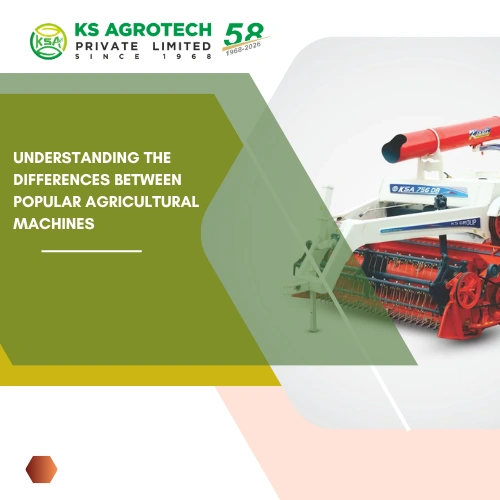
A combine harvester intends to carry out a number of harvesting tasks in one operation. For example, a combine harvester can cut, thresh, separate, clean and distribute the grain. It is particularly useful in situations where the land needs to be harvested quickly.
However, a combine harvester may not be well suited to all post-harvest residue management needs. For example, large quantities of straw tend to be left in the field following harvest, and this is a situation in which additional machinery might play a significant role.
The Straw Reaper is a piece of equipment that is used for collecting leftover straw and crop residue after harvesting. It does not function the same way as a combine; it is used to collect the remaining crop that is left in the field.
A tractor is one of the most flexible pieces of equipment on a farm. It can be used with various attachments and implements for ploughing, tilling, transporting, sowing, managing residues, etc.
The main difference is that a tractor is mostly just a source of power for a lot of implements, rather than doing all of the specialized work alone. Various implements can be plugged on based upon the job at hand.
It is recommended that when selecting the equipment, the tractor that the farmer is already using has adequate horsepower and is a suitable match for the implement to be used. The right fit can enhance the effectiveness of the implement and ease the burden on the tractor.
A baler is not the same as a piece of equipment used to process loose crop straw in the field. It is primarily used to collect crop material and make formed bales.
If the farmer intends to gather up, move, or store crop residues, then baling can be a useful method. It is far easier to move a few compact bales than to move quantities of straw.
But whatever the ideal choice is, it will always be governed by what the farmer’s goal is. If the material to be achieved by the machine is to form into large bales either for storage or road transportation, then a baler will be used; otherwise, a different type of machine would be used to handle the residual material directly at the farm.
The rotavator is essentially for preparing the ground. It works by breaking up and mixing soil, producing a seedbed suitable for the next crop. So has its most important role in land preparation.
The operation of such a machine is therefore very different from that of straw collection and processing machines. It is common to use both varieties of machine during a crop cycle, but they have different uses.
Having the appropriate implement on and using it at the appropriate time can also help reduce extra passes in the field and keep the farm operation running smoothly.
Perhaps the most noticeable difference in modern agricultural machines is the amount of human input needed. The manual removal of residues has been a labor-intensive and time-consuming process.
Using machinery takes some of the pressure off by doing jobs that would normally need a number of men to do. This can be a great help when you are busy and short on men.
The farmer should take into account the size of the area to be covered, the frequency of operation, and the time required to prepare the field before the next operation.
Cost is naturally a significant factor in the decision to buy. But it can be misleading to judge machinery solely by its initial cost.
For instance, the Bhusa Machine Price can be different depending on its capacity, specifications, quality of construction, working width, and features offered. Likewise, the Reaper Price can differ from manufacturer to manufacturer and model to model based on efficiency, power consumption, and quality of construction.
When evaluating the Straw Reaper Price, it is important to include considerations of operating capacity, tractor compatibility, maintenance, durability, and intended use. While a machine might be more expensive initially, it could be more cost-effective in the long run if it is a more efficient machine and has lower maintenance requirements.
Farmers should analyze their precise needs before making a purchase of farm machinery. Farm size is just one of the several relevant parameters.
Farmers need to consider the required tractor horsepower, working capacity, fuel power, availability of spare parts, maintenance and after-sales service required, type of crop, and condition of the field.
Secondly, something which is often overlooked is anticipated usage. Machines which are going to be used over a large area on a regular basis may be worth investing in to a greater extent than equipment which is only going to be used infrequently.
If the right machine is not correctly matched with the tractor or farming conditions, even a high-spec Machine can produce poor results. Before purchasing, farmers should ensure it will fit with their existing equipment.
The straw reaper machine price should be considered as well as its machine specifications and anticipated productivities, rather than just a single value.
A good combination of tractor and implement will enhance performance in the field, minimize breakdowns, and help maintain the equipment within its design limits.
If you are considering purchasing an agricultural machine, it is important to be familiar with the various kinds and their functions. For example, a combine harvester is used for harvesting and threshing, a tractor can be used for various activities, a baler to compress crop leftovers, and a rotavator to prepare the soil.
Farm equipment can be used to support these machines that are being utilized by providing specific tasks at various phases in the farming cycle. The choice of the given piece of equipment can only be based on the crop, acres, tractor capacity, labor, and work to be done.
In selecting equipment, farmers should consider performance, capacity, reliability, ease of service and maintenance, ease of integration with other equipment, and potential usefulness over the long term, not just cost. A good-fit machine should improve time efficiency, lessen the manual labor involved in everyday farm activities, and reduce the overall time needed for operation.