- October 8, 2026
- By: admin
- in: Updates
Not only does modern agriculture focus on producing higher yields, but nowadays farmers have the responsibility to trade, transfer, store and process the stored crops for maximum profits. The entire farming life cycle demands equal attention to the plant and the final product.
The entire cycle of growing crops in the field to storing grains safely for home consumption or marketing; efficiency can greatly cut losses, increase production and farm income. From the widespread use of agricultural machinery to modern farming techniques, farmers have a range of options available for improving each step of the process.
Agricultural production consists of a series of tasks that have to be performed within a relatively short period of time. Setbacks (delays) during harvesting, processing, or storing can result in losses and degradation and diminish the value of the produce.
Efficient farm management helps farmers:
Enhancement of resource inputs during the entire cycle in agriculture would allow food producers to save resources in production and still deliver quality food to the market.
Harvesting is among the most important phases of crop production. Crops should be harvested at an optimum time to retain the quality and to prevent losses through unfavourable weather, pest attack or late harvesting.
Contemporary farm equipment enables harvesting faster, more precisely, and more effectively than it was carried out manually. Mechanical harvesting minimises the need for workforce and accelerates the process.
Efficient harvesting practices offer several benefits:
As agricultural farms keep enlarging, harvesting tractors should be more and more efficient.
After harvesting, crop handling must be carried out in an appropriate way. The separation, cleaning and preparation of cereals for storage has a significant impact on the potential quality and saleability.
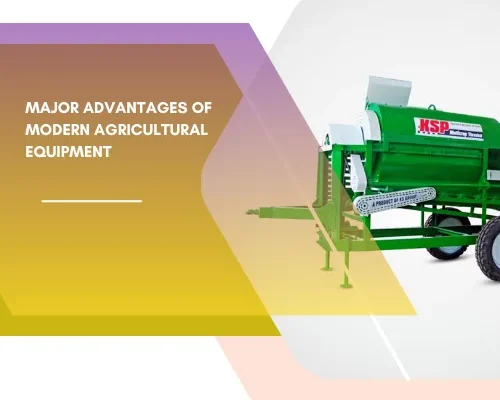
Current threshers that are widely used in modern practice play an important role in this step. For example, a Multicrop Thresher helps farmers in clearing grains from stalks easily while reducing the damage to the grains and improving the total yield. Such machines are adaptable to various kinds of crops, which is so beneficial to diversified farmers.
Effective crop processing provides:
With the aid of sophisticated processing equipment, the farmer can make the harvested crop ready in a timely manner.
Most farmers will grow a variety of crops each year. This is where machinery is required to have settings that are versatile enough so that it is flexible; for example, a maize harvester that can be used on a number of other crops.
Multicrop Thresher Machine: A range of potential products such as wheat, rice, maize, pulses and other grains can be handled by one Multicrop Thresher Machine. This contributes to the optimisation of productivity and to the reduction of the investment cost in the equipment.
The ability to process multiple crops using a single machine offers several advantages:
Multi-purpose machinery is also taking an increasingly prominent place in the diversified farming of today.
Agronomics: Post-harvest losses are one of the biggest problems prevailing in agriculture. Mishandling, delay in processing and wrong storage conditions can cause huge losses in terms of quantity as well as quality.
Common causes of post-harvest losses include:
Today, modern equipment aids in minimising these risks by assisting in the processing of the crop and the Management of contamination at harvest, as well as getting the crop in the right condition for storage. Threshing systems are more efficient and produce cleaner grain for conveyance and storage.
Decreasing loss also helps food security since more products are available to consumers.
Choosing the appropriate pieces of machinery for your farm needs some planning. It is not uncommon for farmers to judge machinery according to its operation, longevity, repair needs and cost-effectiveness.
Finding the equipment: once the education and equipment purchasing decisions are made, buyers often view comparison shopping for Multicrop Thresher Price to see which one will give them the most for their money, from an efficiency and cost standpoint. Although cost is a huge consideration, buyers must also consider how much in productivity a machine will offer, plus long-term savings.
Important factors to evaluate include:
Knowing if buying high-quality machinery will pay for itself has to be weighed up against the reliability costs and efficiency. Reliable machinery can be used profitably for many years, keeping the farm running smoothly.
Once handled, the commodities need to be moved safely from the field to storage. Inefficient handling can cause spillage, contamination, and crushing.
Efficient transportation systems help farmers:
Storage is as essential as preparation. Good storage facilities prevent grain deterioration due to moisture, pests, rats and the environment. The modern practice of storage facilities enables greater shelf life of the grain while providing the farmers with a better opportunity to sell as the market price is right.
Well-managed storage systems contribute to:
Farmers spend a lot of money on the appropriate equipment and have to consider the initial purchase costs as well as the long-term benefits.
Numerous growers, after setting the excess cost, have an eye on the Multicrop Thresher Machine Price budget. Although the ownership expenditure may seem higher for the bigger capacity equipment, the economy in use may compensate for the same.
The true value of farm machinery should be measured through:
A good machine, with generous operating improvements, can pay for itself within a very short period.
Mechanisation and technological developments will be crucial for the success of agriculture in the future. The decline in labour requirements and the increased efficiency of farms will require modern machinery.
To maximise efficiency, farmers are researching the Multicrop Thresher Price in India with hopes of finding a product that fits their needs and budget. As knowledge about modern farming spreads, there is increasing demand for high-tech equipment throughout the land.
Mechanisation supports:
Farmers who adopt modern machines and technology will be equipped for future domestic needs without risking current production.
Trying to improve efficiency, from the field to storage, is crucial to maximise the farmers’ income and the output of their crops. All steps in the process, from harvesting and processing to transport, impact the result.
New equipment and fully mechanised agricultural systems enable farmers to contract less labour, prevent crop failures, enhance quality, and reduce costs. Both in a small farm or a large farm economy, investing in collection and post-harvest management can be very rewarding.
However, due to the advancements in agriculture, being efficient in each step will not only help farmers get higher yields and lower costs but also sustain the farm to develop in the long term.