- October 8, 2026
- By: admin
- in: Updates
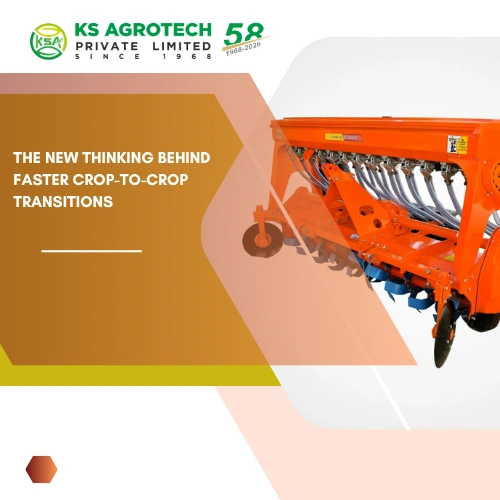
Great strides are being made in field efficiency and the narrow turnaround time from one crop to the next. While overall planting efficiency is taking giant steps forward, fewer field passes and quicker field operations between crop generations also mean greater focus on tools that optimize the use of crop residue and resources. Customers are eager for new equipment to help them combine the field prep and planting tasks into a single pass.
The super seeder model is one step further: combined crop-to-crop transitions that are becoming faster and more practical. While residue handling, soil tillage, and sowing were once entirely separate operations, today’s machinery can enable some of them to be combined, saving farmers precious time within relatively narrow sowing windows and making for easier farm management.
The time between harvest and sowing can be a tight window, especially if the following crop is required to be established within a short time frame. This can impact establishment and require extra work and cost to operate farm machinery and labor.
In conventional farming, putting a field to bed often involved many passes of the tractor. You might have had to remove the crop residue, then till the soil, then drill it. Each step is a lot of fuel, a lot of time, a lot of work.
This process is becoming less relevant with ‘modern machinery’ Because it allows for a number of passes to be made in one.
Among the leading innovations in today´s agriculture is the possibility to sow crops in stubble with the remains of the previous harvest. This practice is especially becoming relevant in those regions where crop residues are becoming a fundamental component of sustainable agriculture.
Contemporary super seeder equipment can be developed to manage residue during soil preparation and seed placement at the proper depth. The goal isn’t about speed but rather an efficient process that minimizes time spent in the field.
Residue remaining on the soil surface can aid in protecting the soil. With local conditions and practices, residue can inhibit erosion, facilitate moisture conservation, and build some organic residue in the soil.
No one machine is perfect for all farms. Tractor power, soil type, field size, the amount of residue, the working width, and cropping patterns in the area all play into the selection of equipment.
Now manufacturers should take this into account instead of spending time discussing those slight differences in purchase price or machines. Use full specifications such as working width, strength of construction, performance of seed placement, ease of maintenance, working depth, and compatibility with existing tractors.
For instance, if a farmer intends to buy a KS Super Seeder with a weight of 7 feet, he should investigate the implement’s total weight to ascertain if it harmonizes with his tractor’s lifting capability, and it is also good to check the field conditions and transportation.
This right combination can smooth the field operation and cut the risk of excess fuel use or poor tractor performance.
Farm equipment is a long-term investment. The implement is good, but after-sales support, availability of spare parts, service availability, and technicians’ help can be as critical.
Compare by the manufacturer, a super seeder manufacturer in India, rather than simply specifications printed on a package. Consider quality of manufacturing, the lifespan of parts, warranty services, access to spare parts, and the local knowledge of the farmer that the manufacturer has.
An honest manufacturer will also have knowledge of the realities of the needs of the farmers with various cropping systems and various types of soil.
Punjab’s ecosystem of such farm equipment is quite robust. The farmer has a crunch of time between rice harvesting and wheat sowing, demanding just-in-time residue disposal and, so, field sowing.
Top-rated super seeders for farmers of Punjab should depend on field service, a suitable tractor, suitability for the field, manufacturing quality, and working efficiency.
The most inexpensive implement might not have the lowest cost of operation over its working life. A machine which has reliable performance, fewer repairs, and can complete its work across the field in less time can be more economical.
Indian farms are very diverse, both in size, soil, cropping pattern and availability of machinery. Therefore, the choice of a super seeder should be aligned to the operational needs and not to some untested best guess.
Questions such as the working width, power requirement, fuel-use efficiency, residue management characteristics, seed metering system, depth control, frame design, and ease of maintenance should be asked. One should get an idea of what the machine is like through demonstrations or by talking to other users.
A machine that is effective in one area, for example, needs to be configured differently in different localities. Local field conditions are thus an essential consideration.
As agricultural mechanization increases, producers in various regions have begun manufacturing machinery that takes Indian farming methods into account. Selling the machinery locally will enable farmers to obtain spare parts and advice more easily.
To purchase a super seeder in Punjab (here), proximity to other service stores and parts supply can be a big edge for consumers. Farmers need to consider manufacturing standards, product tests, customer service, and the presence of trained technicians.
When selecting a manufacturer, your decision should be based on more than simply purchasing equipment. What is required is a core contract for overall support during the life of the asset.
A proper mower tractor selection can ensure good field performance. If the implement is too large and heavy for a tractor to handle, your tractor will burn more fuel, and your operating efficiency will be diminished; a proper tractor-mower match can keep you going strong.
Any grower investigating the qualities of the ideal tractor for super seeder work should examine horsepower, hydraulic lifting capacity, machine horsepower demand, transmission, PTO capacity, tyre arrangement, and soil type.
Tractor & implement as one system: Consider matching implement and tractor to the work to be done, which can be used to increase maneuverability and field capacity, and hence increase productivity.
Cost naturally is always a factor when considering agricultural equipment. So farmers need to put the price into context with the overall cost of ownership.
While searching for super seeder price in Punjab, ensure that you compare all the details of the requested price. In detail, with that price, you can compare the quality, warranty, service, maintenance, fuel cost, and productivity.
The small increase in initial investment may be justifiable if a machine will provide increased durability, reliable performance, greater support, and field efficiency over several years.
We will see more efficiency and performance, multi-functionality, sustainability, and precision in future farm machinery. Farmers must be provided with tools that support them during shorter timeframes of operation and also promote soil and residue management.
The concept of getting from one crop to another faster is therefore less about time per se than cutting out superfluous processes, optimizing machinery and ensuring a smooth transition between one harvest and another.
Machinery that does several of the field jobs at once can be a useful addition as the system of farming keeps on upgrading. The future of the agricultural economy does not just rest on how much land you can farm, but on how you manage each field operation.