- July 30, 2026
- By: admin
- in: News
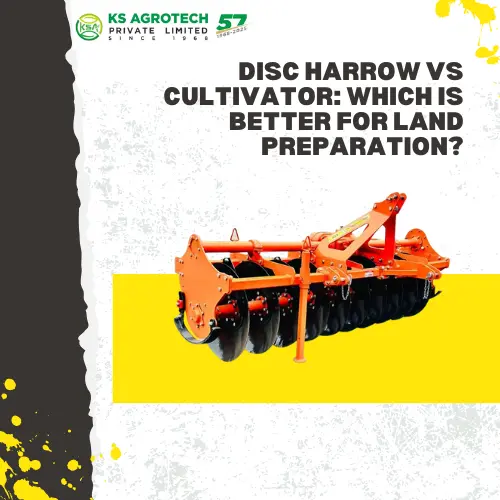
Preparation of the land is a very important process in farming as it directly influences the seed germination, the growth of crops and the yield of crop. The selection of appropriate implement to use in preparing the soil may help to save on labour cost as well as increase in the health of the soil. Some of the most popular farm tools are the disc harrow and the cultivator. Even though both are applied to make land, they are used differently and applicable to various conditions of the fields. In this article, the author identifies the distinction between a disc harrow and a cultivator in order to assist farmers in making a wise choice.
A disc harrow is a sturdier tool of agriculture that is used in primary and secondary tillage. It is made up of rows of concave metal discs that slice through the soil as the tractor drives the implement. These discs tear hard soil clods, slice crop residues and combine organic matter with the soil.
The disc harrows are particularly useful in the soils that are thick, the fields that are stubble and those that are left behind by the harvest. They are normally applied following ploughing or where deep soil penetration is to be undertaken on hard land. The disc harrows are used to prepare the land first and then sowing is resorted to due to their weight and aggressive action.
A cultivator is typically a lighter tool that has tines or shanks which loosen the top soil. It is primarily involved in secondary tillage, weed control and seedbed preparation. The cultivators are used at a relatively shallow depth than disc harrows and are best suited in breaking up surface crusts as well as aerating soil.
The cultivators are usually applied following the primary tillage in order to form an effective seed-bed. They can also be used effectively to weeding between crop rows without having to disturb roots of the plants. Cultivators are easier to use in smaller farms as a result of their light design that makes use of less tractor power.
The main distinction between a disc harrow and a cultivator is their depth of working and effect to the soil. A disc harrow goes deeper into the soil and it is more aggressive and thus it can be used in hard, dry fields or those with residue. A cultivator on the other hand is more towards the surface and more helpful in leveling the soil and controlling the weeds.
The other significant difference is soil mixing capability. Disc harrows blend crop residue with the soil, which contributes to the enhancement of the content of organic matter. Cultivators primarily loosen the soil and remove weeds though not as well incorporated residue.
There is also variation of fuel consumption. The weight of disc harrows and the way they engage with the soil tend to burn more fuel, whereas cultivators are cheaper and more cost-effective when it comes to normal farming activities.
Either disc harrow or cultivator will be used depending on the type of soil, the pattern of crops, and the farming goals.
A disc harrow is preferable to be used on hard, compacted or post-harvest fields that have heavy residue. It is able to slice through organic matter, unearth clods and make the field ready to undergo the other farming process.
A cultivator is better in well-prepared fields or land, which has already received primary tillage. It assists in seedbed refining, weed management, and the enhancement of soil aeration without the excess disturbance of the soil.
Both implements are utilized in most farming systems. The farmers usually harrow the soil initially by discing the soil and then proceed to use a cultivator to smooth the ground before sowing.
Cost is an influential factor in the choice of equipment. Disc harrows tend to be more costly as they are heavy and durable. When choosing equipment to work in medium-sized farms, farmers tend to compare models by their working width, disc size, tractor compatibility, and the 16 disc harrow price is frequently used by them.
Smaller cultivators tend to be less expensive and less in need of maintenance. They are also less wear-part due to their simple design and thus the maintenance process is easier.
Disc harrows use more horsepower in the tractors because in difficult soils, they can hardly be used. Cultivators are also compatible with reduced horsepower tractors, thus small and medium farmers can also use them.
Correct tractor power to implement matching will result to improved performance, less consumption of fuel and life of equipment.
No one is better than the other when comparing disc harrow and cultivator. All of the machines have a certain role in land preparation. Before making a decision, farmers ought to put into consideration soil condition, cropping pattern, tractor capacity and budget.
These manufacturers such as KS Agrotech provide a large selection of land preparation machinery to satisfy various requirements of farming to assist farmers in selecting the appropriate implement to fit their particular requirements.
Disc harrows and cultivators are vital in the modern agriculture. The disc harrow is recommended when the soil is hard and requires breaking and the removal of residue whereas the cultivator is best when preparing the seedbed and controlling the weed. Their differences will enable farmers to exploit one another, thereby increasing productivity and making of healthier crops. The ability to select an appropriate tool in the appropriate phase of farming is the secret of efficient land preparation and the success of the cultivation process.