- July 30, 2026
- By: admin
- in: News
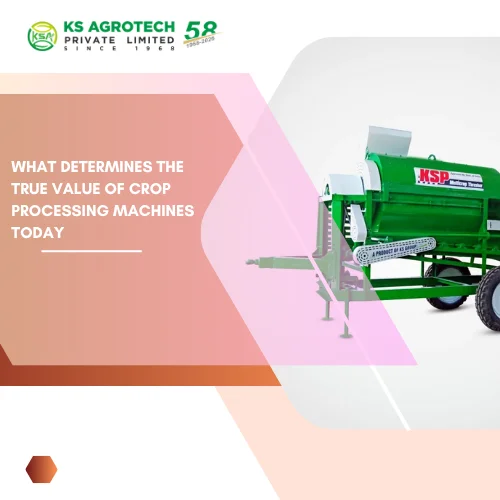
When farmers think about acquiring crop processing equipment, their first thought is usually how much it will cost. But in reality, the worth of a machine is measured by so many things other than its initial price. The factors such as a machine’s performance, reliability, efficiency and potential for creating savings in the long run are very important ways of establishing whether a purchase is worth the money.
Today, the challenge for machines in agriculture is that they must not simply be the ones with the highest performance. Still, they should be the ones whose modus operandi will lead to lesser waste, higher productivity, and better results. Therefore, in the post-harvest area, where, for instance, grain separation and cleaning are the focus, having the right equipment may be the determinant of both the volume of output that you get and your level of profitability.
Efficiency is probably a big deciding point when it comes to the appraisal of farm machinery. Throughput and accuracy both for a crop processing unit basically help the farmer in not only saving time but also the reduction of labor as well as the avoidance of losses that come with unclean separation of grains or aforementioned paper. For these and other benefits, preference for such a machine is often given by the farmer who is determined to maximize the gains from his investment.
The Multicrop Thresher Machine, for instance, is capable of finely processing various types of crops; it will definitely be among the most preferred options if the farm produces different kinds of agricultural products. In fact, agricultural machines that have several functions integrated into a single system lead to less clutter and more productivity in the farm, owing to an overall smooth process flow.
The quality of output is a major aspect that determines the worth of processing machines. Machines of low quality might damage grains or not effectively remove impurities, which lowers their value in the market. Conversely, advanced machinery guarantees thorough separation and less breakage of the product.
Besides, farmers often use various equipment, such as the Multicrop Thresher, to get the job done more efficiently. This tool’s crop versatility feature has made it a popular piece of equipment in recent times. Output quality that is better not only increases a farmer’s profit but also plays a role in gaining the trust of their customers.
It is understood that performance is a vital aspect, but cost is also something that one should not forget. Farmers have to juggle between spending money and enjoying the features and efficiency of a machine. Knowing the Multicrop Thresher Price is a good way of finding out what different models offer and choosing the one that fits the financial and operational requirements.
One must not always associate price with value; a cheap product can cost you more in the end, as it may require constant repairs or may not perform at a consistent level.
Many factors determine the price of agricultural machinery, such as capacity, brand features and location. To get a rough idea of market trends and make informed decisions, farmers usually search for Multicrop Thresher Price In India.
Prices could be influenced by regional differences as well, due to transportation expenses and availability. Farmers, by comparing different market options, can locate equipment that provides a perfect quality – affordability balance.
Purchase of crop processing machinery should be considered as a long-term decision. A good, dependable machine can be a source of service for years, delivering steady performance and lessening operational difficulties.
For many times, as a part of exploring alternatives, farmers tend to base their decisions on the Multicrop Thresher Machine Price to get hold of the cost-value relation. Investing a bit more in a rugged and high-performance machine, in general, pays off with better yields over time.
Modern processing machines have a significant feature of minimizing grain loss, which is one of their major pros. Old
methods can result in considerable wastage, which will have a direct impact on profit. On the other hand, advanced machinery is capable of highly accurate separation and handling so that farmers can get the most out of their grain harvesting. Not only do these machines, by cutting down losses and raising efficiency, produce more output, but they can also enhance the cash flow immediately.
Besides, they increase the income and at the same time assure that the whole experience of working the land is rewarded; in fact, the only way to make money from farming.
Another major factor affecting a machine is its upkeep and maintenance.
If the machine is straightforward to use, this will eliminate the dependency on highly skilled labor, whereas maintenance that requires less time and work is a way to save money. Farmers tend to buy the machines that are easier to handle, require the least training, and spare parts are easy to get. The after-sales service is a great aspect of value in terms of reliability of machinery.
Modern crop processing machines also play an important role in the sustainability of agriculture. They help farmers use resources more effectively by minimizing wastage and increasing efficiency.
When tasks are done more effectively, machinery needs to be operated less often. This leads to less fuel consumption and a smaller overall environmental footprint. Such practices are in line with the increased desire for green farming methods, which not only allow a farm to produce but also look after the environment.
Selecting the right equipment depends on several factors, including farm size, crop type, and budget. Farmers should carefully evaluate their needs before making a decision.
Making an informed choice ensures that the machine delivers maximum value and supports long-term growth.
As technology evolves, crop processing machines are achieving higher levels of efficiency, becoming more user-friendly, and turning more sustainable. Automation and precision farming are likely to be the cornerstones of agriculture in the coming years.
These advancements will enable farmers to handle crop processing more quickly, lower losses, and raise efficiency levels. Enhanced tools and intelligent systems will amplify the importance of agricultural machinery.
Essentially, crop processing machines can greatly contribute to a farmer’s profitability when they handle the work efficiently, minimize wastage, and keep up their good performance level for a long time. Certainly, price matters; however, it shouldn’t be the only criterion for an investment decision.
Grasping concepts like efficiency, robustness, and the benefits over time can help farmers to make decisions that not only increase the volume but at the same time the earnings as well. Getting the right machines is a win-win situation in the sense that you get improved outcomes now, as well as sustainable development in the future are one of the indirect benefits of the investment.