- October 8, 2026
- By: admin
- in: Updates
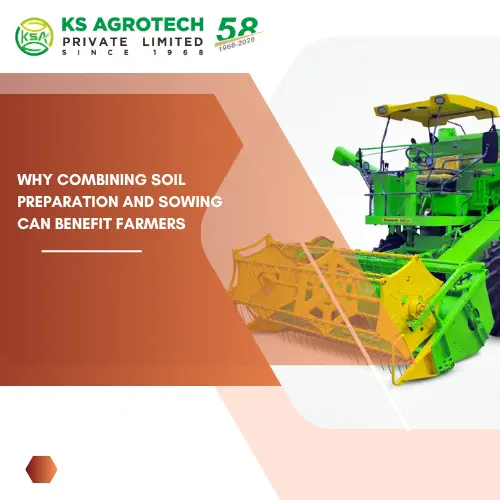
Today, a farmer has to take several field operations within a short period of time. An important point to accomplish these operations is soil preparation and sowing. If they can be achieved with a single pass; it is cheaper, requires less fuel and less operating time.
These operations can be consolidated by using suitable machinery for use on the farm to reduce labour in the finished task. Combining two or more operations, such as soil cultivation and planting on the one machine, eliminates unnecessary traffic on the land and allows improved control of the seed process.
By combining soil preparation and sowing, you will need fewer passes over the field. For separate operations you will need to use two different types of equipment and drive two different implements over the field which will increase tractor power, hours worked and fuel costs.
A combination method enables many jobs to be carried out in one field operation. This is especially advantageous during hectic sowing times, for instance, when farmers have a short window to get large areas of land sown.
Less passes also can decrease re-tracking of the same ground. This may be beneficial in avoiding unnecessary compaction and maintaining more ideal field conditions for crop emergence.
Sowing periods are often bound by strict deadlines. Farmers need to consider climatic conditions, moisture in the soil and the sowing window for particular crops when planning operations in the field. A delay in the period of land preparation will have repercussions on when sowing should take place.
Equipment performing several operations in a single pass allows for improved utilization of available working hours. Instead of the labor intensive practice of prepping the field first then going back for planting,3 different operations can be accomplished.
This may be particularly useful for farms that have a limited window of suitable weather to carry out field operations.
The first step to good seed placement is having the right soil condition. Once the seed is in the ground it needs the right environment to get established and grow good root systems.
During combined operations, after any pre-treatment is completed, the soil can be prepared just prior to seed placement; there is no need to leave the prepared soil exposed while another operation is scheduled.
A good, firm seedbed should allow for more uniform seed placement and should help the seed stay in better contact with the surrounding soil. Results will vary depending on soil type, moisture conditions, crop requirements and machine configuration.
Crop residue can cause problems when preparing the fields and during sowing. Excess residue may cause problems with the machine if it is not removed.
Advances in equipment enable farmers to manage residue in the planting process when preparing the seedbed and the placement of seeds. This could eliminate or reduce the need for other operations prior to planting.
The correct configuration should still be determined by the quantity and type of crop residue in the field. Growers should take account of local conditions rather than assuming that the same configuration will fit all farms.
Each further field pass uses tractor fuel, labour and machine time. Although not the case on a small farm, this could become a costly expense on a large farm during the all important seed time.
By combining operations, machinery will spend less time travelling across the field. This could help reduce fuel consumption per acre, as well as reducing the labour needed.
In addition to the purchase price, farmers should also take into account running costs before making a equipment comparison. These might include maintenance, fuel use, tractor requirements, spare parts and working life.
Before investing in equipment, the farmer should know the specifications and working parameters. A super seeder machine may be a multi-tasking piece of field machinery but the results will depend on the tractor compatibility, soil, working depth, working speed and maintenance.
The tractor must have the required horsepower and lift capacity to carry out the work required. Considerations of the hydraulic requirements and field conditions should also be taken into account before purchasing.
Selecting equipment just on size or cost could be false economy. It is always best to select equipment to match the true requirements of the farm.
Farmers in various parts of the country can have different soil types, crop residues, field sizes, and seasonal circumstances. Local adapted equipment can provide more efficient and feasible working practice.
If you are farmers and looking for a super seeder manufacturer in India, it is best to consider the following aspects: build quality, design of machine, availability of support, availability of spare parts and post-sales service and not any one specification.
During busy sowing periods, the accessibility of local services could be another factor to consider. Fast response time to available technical support and spare parts helps minimize unplanned downtime.
Price is naturally an important element when purchasing any machinery. Farmers should compare the overall value for money obtained from different machines rather than simply go for the cheapest.
Here you can check super seeder price in Punjab by comparing aspects such as construction of machine, working width, operating costs and needs, service and maintenance.
A machine of proper design and dependable parts might be more cost effective in the long run if it minimizes operating time and performs predictably year after year.
A single implement will not be best suited to all farms. Factors such as farm size, soil, crop, crop residues, tractor power and labour should all be considered.
Farmers looking for the best super seeder in Punjab should consider the match to their field specific needs when comparing equipment. Likewise, farmers seeking the best super seeder should evaluate construction, operation, ease of maintenance and compatibility to farm machinery.
In addition, the manufacturer’s reputation and track record can offer valuable insights.
The harsh environment of the field must be endured by agricultural machinery. With good build quality, quality parts and simple design a lot can be achieved in the longer term.
An agricultural implement manufacturer based in Punjab with proficiency on super seeder will have an idea about the problems faced by the farmers in Punjab and the equipment to be designed keeping those needs in mind. Advantages and disadvantages of a particular equipment, warranty coverage, service network, replacement parts and technical guidance should be checked before finalizing the purchase.
However, even a perfectly designed implement may not function well if used with an inappropriate tractor. The field efficiency can be affected by the horsepower, lifting capacity, hydraulic efficiency or tyre configuration.
Farmers can check the power recommended for the machine and match it with their tractor if they want to compare the best tractor for super seeder application.
Having the appropriate tractor and implement match can enhance control, minimize excess stress and promote more fluid field work.
The integration of soil preparation and sowing enables farmers to minimize number of fields visits, optimize operating time, control residues and efficiently use available resources. Furthermore it can help farmers to complete important work in short sowing windows.
Farmers who want the best super seeder in India need to look at the Big Picture, not just one feature. Its operational performance, tractor compatibility, its construction, maintenance costs, service support, and life operating expenses all matter.
In the end, integrating the most essential field operations may help to make the farm operation more integrated and efficient if the equipment is properly selected, calibrated and operated in field situations.